In modern metal processing, maintaining dimensional consistency and production efficiency is an important part of manufacturing operations. As product requirements become more demanding, manufacturers continue to evaluate different straightening methods to achieve stable processing results.
Traditional straightening methods, such as two-roll and press-type systems, continue to be used in various applications. However, multi-roller straightening machines are commonly adopted in applications that require improved straightness consistency and higher production efficiency.
This article examines the differences between traditional and multi-roller straightening methods and discusses their respective applications in metal processing.
What Are Multi-Roller Straightening Machines?
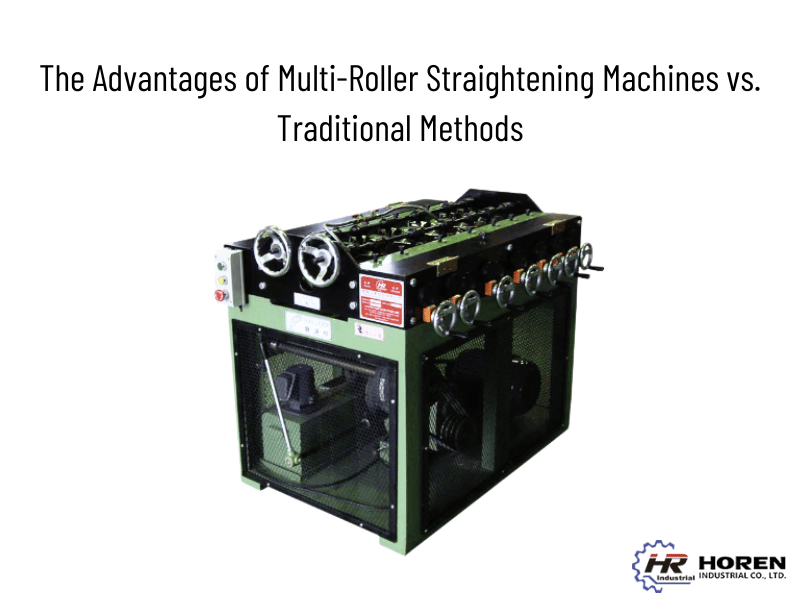
A multi-roller straightening machine uses a series of alternating upper and lower rollers—typically ranging from 6 to 13 rollers depending on the machine configuration—to gradually correct the curvature of metal bars or tubes.
Each roller applies a controlled corrective force at a specific position along the material. By distributing the straightening process across multiple rollers, the machine helps improve straightness consistency while reducing excessive localized deformation.
Traditional Straightening Methods
Traditional straightening equipment generally falls into two categories:
Two-Roll Straighteners
These machines use a pair of opposing rollers to straighten or align materials.
Press-Type Straighteners
Hydraulic or mechanical force is applied to correct localized bends or distortions.
Depending on the material, production volume, and straightness requirements, these methods may have limitations in terms of processing efficiency, repeatability, and adjustment flexibility.
Key Advantages of Multi-Roller Straightening Machines
1. Improved Straightness Consistency
Multi-roller systems apply corrective force at multiple points along the material, helping achieve more consistent straightening results throughout the production process.
This is particularly beneficial for applications requiring stable dimensional control and repeatable processing conditions.
2. Distributed Straightening Force
Because corrective force is distributed across multiple rollers, deformation is applied more gradually throughout the straightening process.
This approach can help reduce excessive localized stress during material correction.
3. Suitable for Continuous Production
Multi-roller straightening machines are designed for continuous processing and can be integrated into automated production lines.
Automatic feeding and collection systems may help reduce manual handling and improve production efficiency.
4. Enhanced Adjustability and Control
Modern multi-roller straightening machines are often equipped with position indicators, servo systems, and inverter-based speed control.
These features allow operators to adjust roller positions and processing speed according to material specifications and production requirements.
5. Adaptability to Different Materials
Multi-roller straightening machines are commonly used for processing round bars and round tubes manufactured from steel, stainless steel, copper, aluminum, and various alloy materials.
Different machine configurations can be selected according to material size and processing requirements.
Typical Applications
Multi-roller straightening machines are commonly used in the production of:
- Automotive bars and tubes
- Aerospace material processing
- Metal fasteners
- Construction materials
- General industrial components
The specific application depends on material characteristics, dimensional requirements, and downstream manufacturing processes.
HOREN Multi-Roller Straightening Machines
At HOREN INDUSTRIAL CO., LTD., our horizontal multi-roller straightening machines are designed to support stable and efficient metal processing operations.
Key features include:
- Heavy-duty machine structure
- Precision-machined rollers
- Adjustable roller positions with scale indicators
- Inverter-controlled processing speed
- Integration capability with automated production systems
Various machine configurations are available according to material size, production volume, and processing requirements.
Conclusion
Traditional straightening machines remain suitable for certain applications, particularly where production volume or straightness requirements are relatively moderate. However, multi-roller straightening machines offer advantages in terms of process consistency, production efficiency, and adjustment flexibility.
By utilizing multiple rollers to gradually correct material deformation, these machines are commonly used for processing round bars and tubes across a variety of industries.
When selecting straightening equipment, manufacturers should consider factors such as material type, size range, production requirements, and downstream processes to determine the most suitable solution for their application.
Contact Us
If you would like to learn more about HOREN's multi-roller straightening machines, please contact us. Our team can help evaluate your material specifications, straightness requirements, and production goals to recommend a suitable solution for your application.
