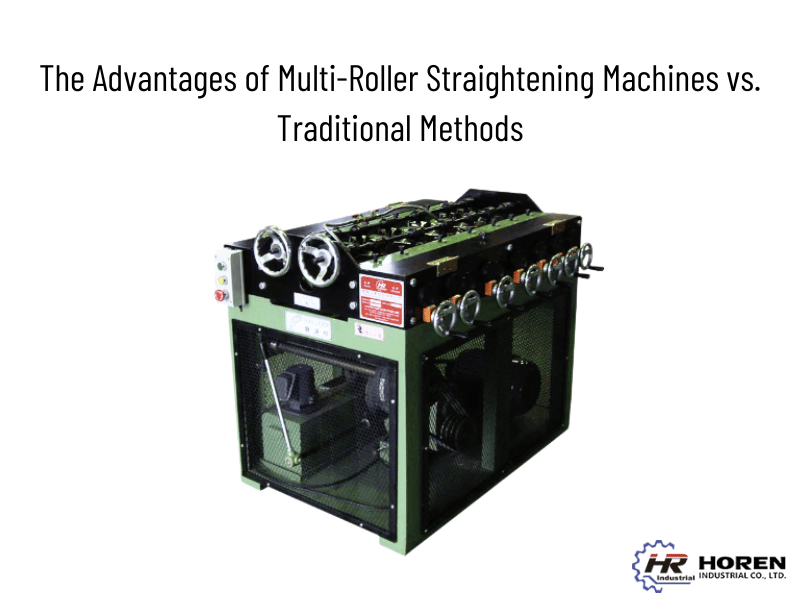
The Advantages of Multi-Roller Straightening Machines vs. Traditional Methods
In modern metal processing, precision and efficiency are everything. As manufacturers aim to reduce defects, increase throughput, and meet ever-tightening tolerances, the equipment used for critical processes like straightening must evolve accordingly. Traditional straightening methods, such as two-roll or press-type machines, have long served the industry—but when it comes to high-speed, high-accuracy operations, multi-roller straightening machines have proven to be the superior choice.
This article explores the key differences between traditional and multi-roller straightening technologies, and outlines why the latter has become the preferred solution in many industrial applications.
What Are Multi-Roller Straightening Machines?
A multi-roller straightening machine uses a series of alternating top and bottom rollers—typically 6 to 13 rollers depending on the model—to gradually correct the curvature of metal bars, tubes, or wires. Each roller is positioned to apply precise corrective force at specific points along the material, allowing for incremental bending in both directions. This controlled process minimizes residual stress and delivers a straighter, more uniform result.
Limitations of Traditional Straightening Methods
Traditional straightening machines usually fall into two categories:
- Two-Roll Straighteners: These use a single pair of opposing rollers to flatten or align material.
- Press-Type Straighteners: Hydraulic presses apply force to correct localized bends or warps.
While useful for simple or low-volume jobs, these methods suffer from several drawbacks:
- Lack of precision for tight tolerances
- High risk of overbending or introducing new deformations
- Slower processing speeds
- Limited automation capability
- Greater material stress due to force concentration
Key Advantages of Multi-Roller Straightening Machines
1. Superior Straightening Accuracy
Multi-roller systems apply smaller corrective forces at multiple points, which results in more precise alignment. This is critical for industries such as aerospace, automotive, and medical device manufacturing, where dimensional tolerances are often measured in microns.
2. Less Stress, Better Material Integrity
Because the force is distributed across many rollers, multi-roller machines reduce the risk of micro-cracks, surface scarring, or internal stress buildup. This is particularly important for materials like stainless steel, titanium, or aluminum, which are sensitive to deformation during forming.
3. Faster and More Consistent Throughput
Multi-roller machines are designed for high-speed processing and are capable of running continuously with minimal operator input. With automated feeding, adjusting, and collecting systems, they can support 24/7 production lines with consistent quality.
4. Enhanced Adjustability and Control
Modern multi-roller machines are equipped with precision dial indicators, servo systems, and inverter-based speed control. These features allow fine-tuning of roller positions and processing speed based on material type, thickness, and diameter—something that traditional systems cannot match.
5. Versatility Across Material Types and Shapes
Multi-roller systems are suitable for round bars, tubes, square rods, and even profiles. They also handle a wide range of materials, from soft copper to high-strength alloy steels, making them adaptable to various industry needs.
Industry Applications Benefiting from Multi-Roller Straightening
- Automotive: Fuel lines, suspension rods, steering components
- Aerospace: Structural rods, fasteners, titanium tubes
- Medical Devices: Surgical wires, catheter components
- Construction: Rebar, support rods, metal framing
- Energy: Tubing for oil & gas, wind turbine shafts, power grid supports
Why Horen Industrial Co., Ltd. Recommends Multi-Roller Technology
At Horen Industrial Co., Ltd., we’ve seen firsthand how upgrading to multi-roller straightening machines transforms our clients' productivity and quality control. Our horizontal multi-roller straightening systems are:
- Built with robust frames and precision-ground rollers
- Designed for easy integration with automated production lines
- Equipped with adjustable roller settings with scale indicators
- Available in various configurations to match your production volume and material specs
Conclusion
While traditional straightening machines still have a place in low-volume or coarse-tolerance applications, the demands of modern manufacturing require more advanced solutions. Multi-roller straightening machines offer unmatched precision, efficiency, and flexibility, making them the ideal choice for manufacturers who refuse to compromise on quality.
If you're looking to upgrade your metal processing line or improve the straightness and quality of your products, multi-roller technology is the future—and Horen is here to help you make the shift.