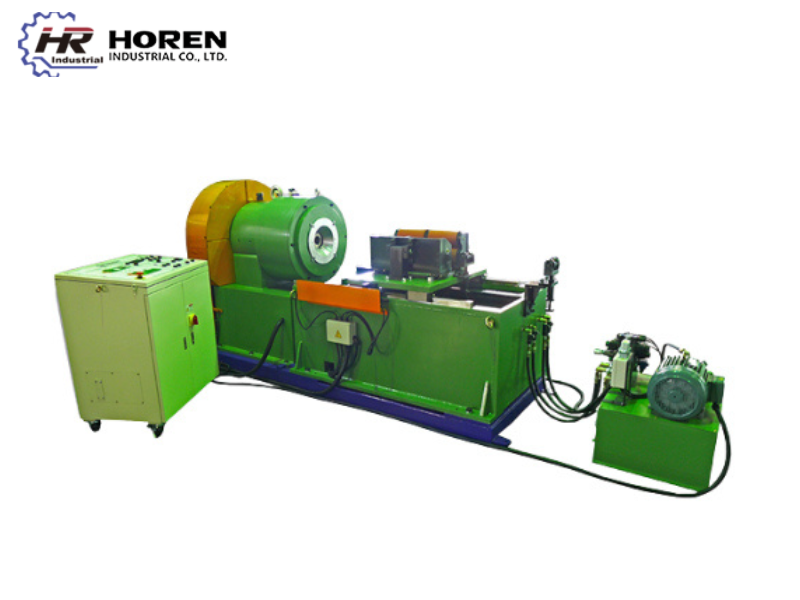
How to Choose the Right Swaging Machine for Your Production Line
In the world of precision tube and pipe forming, selecting the right swaging machine can make or break your production efficiency and product quality. Whether you're manufacturing automotive components, medical tubing, or aerospace parts, the swaging process ensures tight dimensional control, improved material strength, and minimal material waste. At HOREN INDUSTRIAL CO., LTD., we offer a wide range of swaging machines designed to meet the evolving demands of modern metal forming industries.
This article explores how to choose the right swaging machine for your production line, analyzes the differences between swaging and other forming methods (e.g., spinning or roll forming), and highlights key use cases across industries.
1. Understand Your Product Requirements
Begin by analyzing the materials you work with—whether it’s stainless steel tubing, aluminum shafts, or precision connectors. Each material type reacts differently to compressive force. Swaging machines are ideal for parts that require:
- Dimensional consistency
- Improved surface finish
- Internal or external diameter reduction
- Stress-free cold forming
2. Key Machine Features to Consider
When selecting a swaging machine, evaluate the following critical specifications:
- Working Diameter Range – Match the machine's forming capacity with the smallest and largest part diameters you process.
- Swaging Frequency – HOREN's machines offer high-speed swaging for enhanced productivity.
- Feeding System – An automated infeed system reduces labor and ensures consistency in mass production.
- Control System – Modern CNC or PLC control allows for programmable forming cycles and repeatable accuracy.
- Cooling and Noise Reduction – Features like integrated cooling and noise-reducing covers increase operator safety and equipment longevity.
3. Compare with Other Forming Technologies
| Feature | Swaging Machine | Crimping Machine | Cold Forming Press |
|---|---|---|---|
| Forming Principle | Radial hammering with rollers | Localized squeezing | Axial compression with dies |
| Precision Level | High | Medium | Medium–High |
| Tooling Wear | Moderate | High | Moderate |
| Noise Level | Low with cover | Low | High |
| Best For | Tubes, shafts, connectors | Wiring, small terminals | Large-volume symmetrical parts |
4. Extended Applications in Various Industries
Swaging technology is increasingly adopted across:
- Automotive: Drive shafts, airbag inflator tubes, and fuel system components
- Aerospace: Lightweight structural tubing and fittings
- Medical: Stainless steel hypodermic tubing and surgical instruments
- Construction: Steel cable terminations and fasteners
- Electronics: Connector housings and shielding tubes
Conclusion
Choosing the right swaging machine involves understanding your material and dimensional needs, comparing machine features, and evaluating alternative processes. As a trusted manufacturer, HOREN is committed to delivering reliable forming solutions tailored to your production challenges. Contact us today to discuss your project requirements or request a customized machine recommendation.