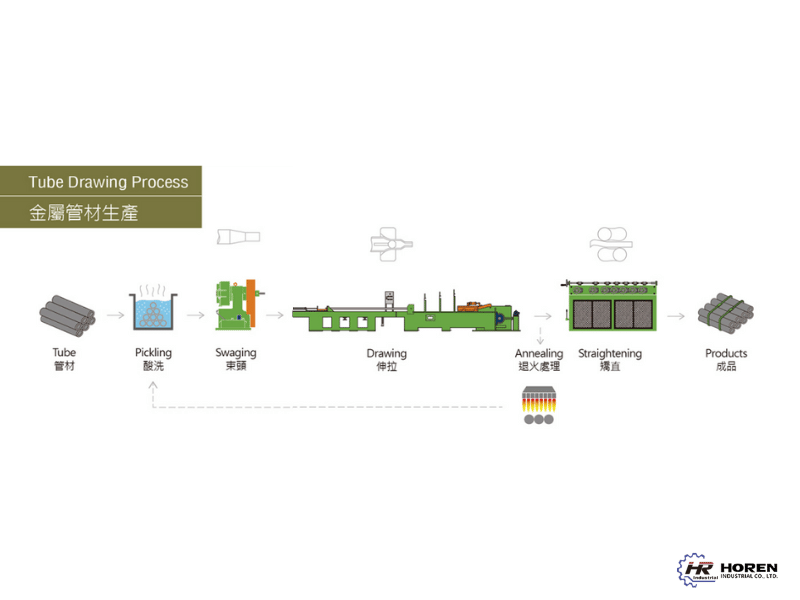
Building a Precision Bar & Tube Production Line: From Swaging to Straightening
At Horen Industrial Co., Ltd., we specialize in designing and manufacturing metal forming machinery for precision bar and tube production. Over the years, we’ve worked closely with manufacturers across automotive, medical, aerospace, and industrial sectors. One consistent lesson we’ve learned is this:
High-precision metal products are never achieved by a single process alone.
That is why we develop and supply three key machines as a complete forming chain:
Swaging Machine → Cold Drawing Machine → Straightening Machine
Each plays a critical role. When designed to work together, they form a stable, efficient, and highly precise production line.
How We See the Role of Each Machine in the Production Chain
Swaging – Preparing the Workpiece for Successful Drawing
In most drawing operations, the first challenge is simple but crucial: How do we introduce the bar or tube smoothly into the drawing die?
This is where swaging becomes essential. Our swaging machines reshape or reduce the workpiece end so it can enter the die correctly and be gripped securely during pulling.
From our experience, proper swaging brings clear benefits:
- Smoother die entry
- Stable drawing force
- Lower risk of cracking
- Longer die life
- Higher first-pass drawing success rate
This step is especially important when working with stainless steel, alloy steel, titanium, or thick-wall tubing.
Cold Drawing – Achieving Dimensional Precision and Strength
Once the workpiece is correctly prepared, cold drawing refines it to final size.
Our automatic cold drawing machines are designed to:
- Control pulling speed with inverter systems
- Apply consistent drawing force
- Improve tensile strength through grain refinement
- Deliver tight diameter tolerance
- Produce excellent surface finish
However, we also know that cold drawing naturally introduces residual internal stress, especially in long bars and tubes. This stress often results in slight bending after drawing.
That leads directly to the next essential process.
Straightening – Delivering Final Geometric Accuracy
After drawing, straightness becomes the final quality gate.
Our multi-roller straightening machines apply controlled alternating pressure through staggered rollers. This gradually removes curvature without damaging surface quality or introducing new stress.
Straightening ensures that the final product is ready for:
- CNC machining
- Welding and assembly
- Rotating shaft applications
- High-precision alignment requirements
Without proper straightening, even a perfectly drawn bar can fail downstream machining or assembly.
Why Many Industries Require All Three Machines
From our customer base, we commonly see all three machines installed together in:
- Automotive Manufacturing: Drive shafts, suspension rods, steering columns, brake and fuel tubing
- Medical Device Manufacturing: Surgical tool shafts, orthopedic pins, catheter guide tubes
- Aerospace & Defense: Titanium hydraulic tubes, alloy control rods, actuator components
- Energy & Oil & Gas: High-pressure tubing, coupling preforms, valve stems
- Industrial Machinery: Linear shafts, cylinder rods, structural precision bars
In these industries, strength, precision, and straightness are all functional requirements — not cosmetic features.
Why We Manufacture All Three Machines In-House
One reason customers choose Horen is that we design swaging, cold drawing, and straightening machines under one engineering philosophy.
This gives our customers practical advantages:
- Matching forming force and feed speed across machines
- Easier mechanical alignment between process stages
- Consistent automation and PLC control logic
- Faster line commissioning
- Simplified maintenance and technical support
When machines are sourced from different suppliers, integration becomes complex. By providing a complete forming solution, we help customers avoid that risk.
What This Means for Manufacturers
By implementing a complete forming sequence:
Swaging → Cold Drawing → Straightening
manufacturers achieve:
- Higher drawing stability
- Lower scrap rates
- Better tool life
- Consistent dimensional accuracy
- Reliable straightness
- Easier automation expansion
This directly translates into:
- Reduced production cost
- Improved yield
- Faster throughput
- Stronger and more uniform products
Our Perspective
From our standpoint as machine designers, the goal is not simply to sell individual machines. It is to help manufacturers build stable, scalable, and precision-driven production lines.
That is why we continue to refine each stage of the forming process — from swaging to drawing to straightening — as part of one integrated solution.
If you are planning a new bar or tube production line, or upgrading an existing process, we are always ready to discuss your material type, size range, and throughput requirements — and help you design the right forming sequence from the start.
Horen Industrial Co., Ltd.
Precision Forming Machinery for Modern Manufacturing