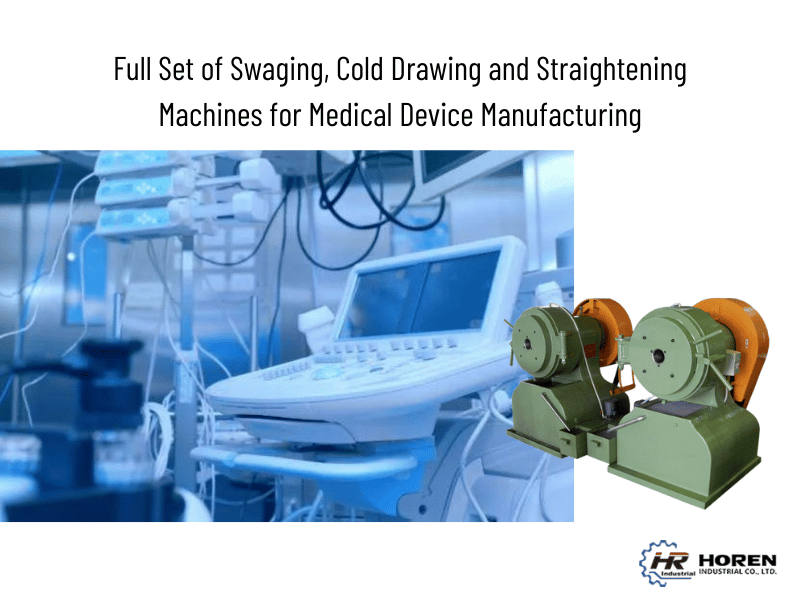
Full Set of Swaging, Cold Drawing and Straightening Machines for Medical Device Manufacturing
In precision metal processing, especially for the medical industry, achieving tight dimensional tolerances, excellent surface quality, and structural integrity requires a coordinated sequence of forming processes. At HOREN Industrial Co., Ltd., we specialize in designing and manufacturing a complete set of metal forming solutions — including swaging machines, cold drawing machines, and straightening machines — that work together to meet the demanding requirements of medical device production.
Founded in Taiwan, HOREN Industrial focuses on precision metal forming machinery and automated production solutions. With extensive experience in bar and tube processing equipment, we support global manufacturers in improving productivity, reducing waste, and maintaining consistent product quality across demanding applications.
Why Integrated Forming Machines Matter in Medical Manufacturing
Medical device components such as surgical tool shafts, implantable pins, catheter guide tubes, and precision medical instruments must meet strict standards for dimensional accuracy, surface finish, mechanical strength, and straightness. These requirements are not easily achieved with a single machine or forming step. Instead, a complete production solution — combining swaging, cold drawing, and straightening — is often necessary.
These machines are designed to work in a seamless sequence:
Swaging Machine → Cold Drawing Machine → Straightening Machine
Each stage prepares the part for the next to ensure quality, consistency, and productivity.
Stage 1 — Swaging: Forming Entry Geometry for Precision Drawing
Swaging is used as a pre-form step to reshape or reduce the end of a workpiece before it enters a drawing die. In medical manufacturing, swaging helps:
- Reduce die entry stress
- Create controlled tapered ends
- Improve first-pass drawing success rate
- Extend tool life
- Enable stable gripping during drawing
This step is particularly important for stainless steel, titanium, and high-strength alloy tubes frequently used in medical applications.
Stage 2 — Cold Drawing: Achieving Tight Tolerance and Material Strength
Cold drawing pulls the pre-formed bar or tube through a precision die to reduce diameter and refine mechanical properties. Medical manufacturers rely on cold drawing to achieve:
- Tight outer diameter and inner diameter tolerance
- Better surface finish
- Improved tensile strength and yield strength
- Grain structure refinement
- Enhanced fatigue performance
Automatic cold drawing machines equipped with PLC control and inverter-based speed regulation further enhance repeatability and throughput — crucial factors for medical device production where each batch must comply with strict quality systems.
Stage 3 — Straightening: Ensuring Geometric and Functional Accuracy
Cold drawing introduces residual internal stresses, which often cause slight bending or curvature. Even small deviations can be unacceptable in medical applications. Straightening machines eliminate these deformations by applying controlled pressures through multiple rollers to restore linearity.
Medical device components that benefit from straightening include:
- Guide tubes for endoscopes and catheters
- Precision shafts for surgical instruments
- Long implants requiring exact alignment
- High-precision rods used in robotic medical devices
Straightened parts improve downstream machining, assembly, and functional performance.
Typical Medical Materials Processed with This Full Forming Line
A full swaging → cold drawing → straightening sequence is particularly beneficial for materials such as:
- 304 / 316L stainless steel
- Titanium alloys
- Nitinol
- Nickel and cobalt specialty alloys
- Precision micro-diameter tubes
- Surgical grade carbon steel
Each material has different deformation behavior, which is why adjustable forming force, speed control, and staged processing are critical.
Why Medical Manufacturers Prefer a Full Machine Set
Combining swaging, cold drawing, and straightening into one controlled production line provides several operational advantages.
Process Stability
Each forming stage is optimized for its function and supports the next step in the process chain.
Higher Yield and Lower Rework
Proper entry preparation, precision drawing, and final straightening reduce rejection and secondary correction work.
Better Tool Life
Controlled pre-forming reduces drawing die shock and wear.
Automation and Repeatability
PLC-controlled systems support parameter recording and repeatable operation — important for regulated medical production environments.
Simplified Integration
Sourcing all machines from one manufacturer improves compatibility and simplifies technical support.
Cross-Industry Value of Integrated Forming Lines
While this forming sequence is highly valuable in medical device manufacturing, the same full machine set is also widely used in:
- Automotive component production
- Aerospace tubing and rods
- Industrial automation equipment
- Energy and oil & gas precision parts
- Robotics and instrumentation shafts
The HOREN Approach
At HOREN Industrial Co., Ltd., we design swaging, cold drawing, and straightening machines as complementary systems rather than isolated units. Our engineering approach focuses on mechanical compatibility, automation readiness, and long-term production reliability.
By providing a full machine set, we help manufacturers build scalable and precision-focused production lines for demanding applications.
Product range reference:
https://www.horenco.com/products_list?lang=en
Conclusion
Medical device manufacturing requires precision at every stage. A full set of swaging, cold drawing, and straightening machines supports controlled dimensional accuracy, consistent surface quality, reliable straightness, and stable production output.
For manufacturers planning new capacity or upgrading existing processes, an integrated forming solution provides a strong foundation for quality and efficiency.
HOREN Industrial Co., Ltd. provides precision forming machinery designed to support high-standard bar and tube manufacturing across medical and other advanced industries.