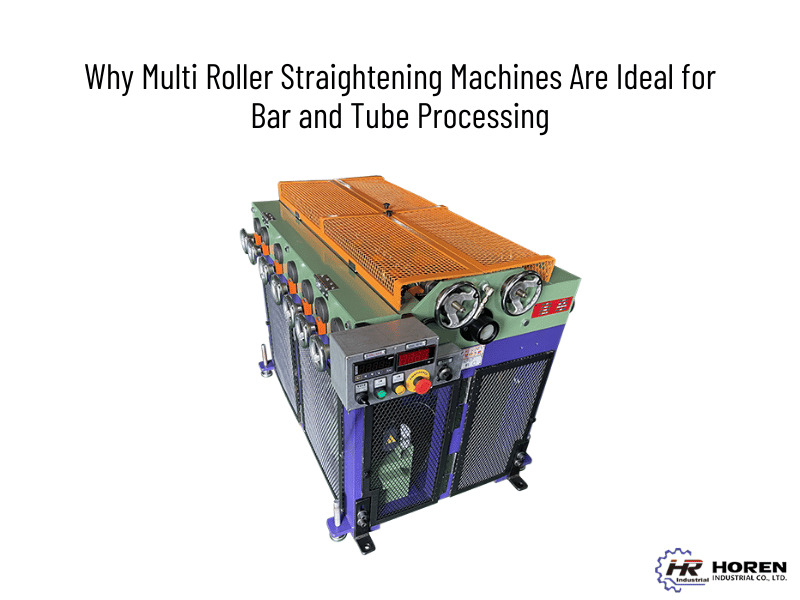
Why Multi Roller Straightening Machines Are Ideal for Bar and Tube Processing
At HOREN INDUSTRIAL CO., LTD., we specialize in designing and manufacturing metal forming equipment for precision bar and tube production. Over the years, we have worked closely with manufacturers in automotive, medical, aerospace, and industrial sectors, helping them improve straightness, dimensional consistency, and production stability in demanding metal processing applications.
In our previous article, “Types of Straightening Machine,” we introduced the major categories of straightening equipment used in metal processing, from roller straightening and rotary straightening to press, stretch, and heat straightening. That article provided a broad overview of available straightening methods and explained that each type serves different materials, geometries, and accuracy requirements.
The next practical question for many manufacturers is more specific: which type of straightening machine is best suited for bar and tube processing?
From our experience, the answer often points to one solution: the multi roller straightening machine.
Why Straightness Matters in Bar and Tube Manufacturing
In bar and tube production, straightness is not just a visual requirement. It directly affects how the workpiece performs in downstream processes such as machining, welding, cutting, assembly, and automated feeding. A slight bend or residual curvature can lead to unstable clamping, vibration during machining, inaccurate cutting lengths, or poor alignment in the final product.
This becomes especially important after processes such as:
- Swaging
- Cold drawing
- Heat treatment
- Transport and storage
Each of these steps can introduce internal stress or slight deformation. Even if a bar or tube meets diameter tolerance, poor straightness can still cause rejection in later stages. That is why straightening is a critical finishing step in many precision manufacturing lines. As we noted in our earlier article, straightening machines play a pivotal role in correcting deformities in metal bars, tubes, and profiles so they are ready for further processing or final use.
What Makes Multi Roller Straightening Different
Among the various types of straightening machines, multi roller straightening stands out because it corrects deformation gradually rather than through concentrated force at only one or two points.
In our previous article, we explained that multi-roll straighteners use multiple rolls, often in a staggered configuration, to straighten materials, and that this approach offers high precision while allowing adjustment for different straightness requirements.
That principle is exactly why this type of machine is especially effective for bar and tube applications.
Instead of forcing the workpiece into shape in one aggressive step, a multi roller system applies controlled correction over several contact points. This creates several advantages:
1. More Precise Straightness Control
Bars and tubes often require fine correction rather than heavy deformation. A multi roller arrangement makes it possible to gradually remove curvature with better control.
2. Lower Risk of Surface Damage
Because the pressure is distributed across multiple rollers, the workpiece experiences less localized stress. This is important when surface quality must be preserved.
3. Better Stability for Long Workpieces
Long bars and tubes can be difficult to control using simpler straightening methods. A staggered multi roller design gives more stable correction over the full length.
4. Greater Adaptability
Different diameters, materials, and product shapes can be handled by adjusting roller positions and machine speed.
Why We Use This Design in Our Own Straightening Machines
At HOREN, our Multi-Roller Shaft/Tube Straightening Machine is specifically designed for bar and tube processing. In our original straightening article, we highlighted several core features of our machine, and these features explain why we consider multi roller straightening to be such an effective solution.
Horizontal Staggered Design
We use a horizontal staggered roller layout with multi-wheel rolling and extrusion adjustment. This design helps us apply corrective force more evenly, which improves straightening precision while minimizing stress concentration on the material.
Precision Scale Equipped Rollers
Each roller is equipped with a scale so operators can record and repeat setup positions more efficiently. This is especially useful when processing repeated product sizes or managing frequent changeovers.
Variable Frequency Drive
Our machine includes VFD speed control, allowing operators to adjust processing speed depending on the material type and production requirement. This improves flexibility when processing a range of metals.
Automation Integration
Our straightening machines can also be integrated with automatic loading, feeding, and unloading systems, making them suitable for customers who want to reduce manual handling and improve line efficiency.
These design choices are not just machine features. They are direct responses to real production challenges in bar and tube processing.
Where Multi Roller Straightening Fits in the Production Line
From our perspective, straightening should not be viewed as an isolated machine function. It should be seen as part of a broader forming sequence.
In many applications, our customers use straightening after upstream processes such as:
Swaging → Cold Drawing → Straightening
This sequence is common because:
- Swaging prepares the workpiece end for drawing
- Cold drawing refines diameter and improves mechanical properties
- Straightening restores final geometric accuracy
In fact, in our earlier article we noted that our bar and tube straightening machine is designed to complement processes such as cold drawing, bending, machining, cutting, and packaging/transportation.
This is one reason why multi roller straightening machines are especially important in industries that require a full processing chain rather than a single standalone step.
Typical Applications in Modern Manufacturing
From our customer experience, multi roller straightening machines are ideal for industries that process precision bars and tubes, such as:
-
Automotive Manufacturing
Drive shafts, suspension rods, steering components, and fluid tubes all benefit from improved straightness before machining or assembly.
-
Aerospace Manufacturing
Precision tubes and control rods often require stable geometric accuracy after drawing or heat treatment.
-
Industrial Machinery
Linear shafts, hydraulic rods, guide bars, and structural precision components require straightness for proper fit and motion performance.
-
Medical and Precision Equipment
Long, small-diameter bars and tubes used in precision devices require straightness for assembly accuracy and consistent function.
These applications share one thing in common: the workpiece must not only be the right size — it must also be straight enough for the next operation.
Why This Matters for Manufacturers
When manufacturers compare straightening technologies, they often focus first on machine type or initial cost. But in our view, the more important question is:
What kind of workpiece are you trying to protect and prepare for the next stage?
For bar and tube processing, multi roller straightening offers a strong balance of:
- Precision
- Productivity
- Repeatability
- Material protection
- Integration with automated lines
That balance is why it continues to be one of the most practical choices for manufacturers who need reliable straightening performance without sacrificing throughput.
Our Perspective at HOREN
At HOREN INDUSTRIAL CO., LTD., we do not see straightening as a standalone correction step. We see it as a critical part of precision metal forming. Because we also manufacture swaging machines and cold drawing machines, we understand how straightening connects with earlier processes in the production line. That broader perspective helps us design machines that are not only accurate on their own, but also practical in real manufacturing environments.
Our product lineup includes Swaging Machine, Cold Drawing Machine, Automatic Cold Drawing Machine, and Multi Roller Straightening Machine, reflecting our long-term focus on integrated bar and tube processing solutions.
Conclusion
If the goal is to straighten bars and tubes with precision, consistency, and production efficiency, multi roller straightening machines remain one of the most effective solutions available.
From our point of view, the reason is clear: they provide gradual, stable correction across multiple contact points, making them especially suitable for workpieces that must move on to critical downstream operations.
At HOREN INDUSTRIAL CO., LTD., we continue to develop multi roller straightening solutions based on the real needs of modern manufacturers — especially those working with precision bars and tubes in demanding industries.