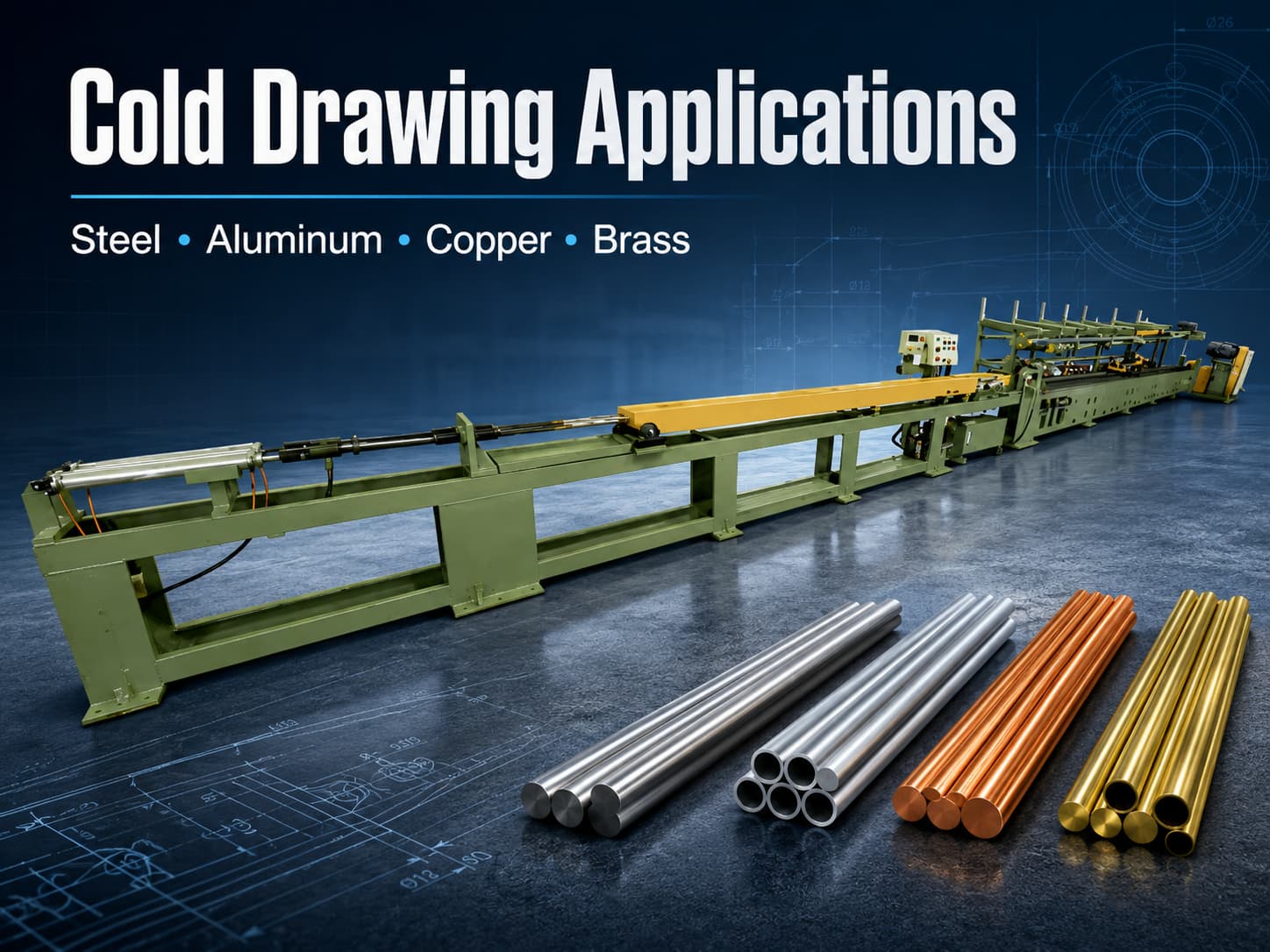
Cold drawing is one of the most practical and widely used metal processing methods for manufacturers that require tighter dimensional control, improved surface finish, and more consistent mechanical properties. While the basic principle is straightforward—pulling metal through a die at room temperature—the results can vary significantly depending on the material being processed.
For manufacturers working with steel, aluminum, copper, and brass, understanding how cold drawing applies to each material is important not only for product quality, but also for machine selection, process planning, and downstream production efficiency. At HOREN INDUSTRIAL CO., LTD., we design cold drawing machines for precision processing of metal bars, rods, tubes, and wires, and we regularly see how different material types influence production strategy.
This article explains how cold drawing is used across these four material categories and what manufacturers should pay attention to when evaluating the process.
Why Cold Drawing Matters Across Different Materials
Cold drawing is used because it improves multiple product characteristics in one process. By drawing metal through a precision die, manufacturers can achieve:
- tighter dimensional tolerance
- smoother surface finish
- improved concentricity and profile consistency
- increased tensile strength and hardness
- better material preparation for downstream operations
These benefits apply across many industries, but the process behaves differently depending on whether the material is steel, aluminum, copper, or brass. Material strength, ductility, friction behavior, and work hardening characteristics all affect how the drawing operation should be controlled.
That is why material-specific understanding is essential. For manufacturers also evaluating industry-focused applications, you may also refer to our related article, Why Automotive and Aerospace Manufacturers Use Cold Drawing for High-Precision Metal Components.
Cold Drawing Applications in Steel Processing
Steel remains one of the most common materials used in cold drawing because it supports a wide range of industrial applications and offers strong mechanical performance after processing. Depending on the grade, steel can be drawn into rods, bars, tubes, and wires used for:
- automotive shafts and rods
- structural and industrial components
- mechanical parts for machining
- high-strength tubes and bars for fabrication
- downstream heat treatment or straightening operations
From a manufacturing perspective, cold drawing helps steel achieve more stable dimensions and improved strength. This is especially useful when the final product must move into machining, threading, cutting, or assembly. Since steel is widely used in production environments where durability and load resistance are important, drawn steel products often serve as semi-finished stock for higher-value parts.
However, steel also requires stable draw force and careful process control, especially at larger diameters or with harder grades. Machine capacity, lubrication, and die condition all play an important role in maintaining production stability.
Cold Drawing Applications in Aluminum Processing
Aluminum offers a very different set of advantages. Manufacturers choose aluminum because it is lightweight, corrosion-resistant, and easier to form than many steel grades. In cold drawing, aluminum is often used for:
- lightweight tubes
- precision profiles
- structural parts requiring weight reduction
- industrial and transportation components
- parts requiring good surface appearance
Compared with steel, aluminum is generally easier to deform, but it also requires careful handling to avoid surface damage and instability in profile quality. Because the material is softer, dimensional consistency and surface control become especially important.
Cold drawing helps aluminum manufacturers improve section consistency and achieve tighter tolerances for later cutting, forming, or assembly. In industries where both precision and reduced weight matter, cold drawn aluminum products are often preferred over less controlled forming methods.
Manufacturers should also note that aluminum alloys vary significantly in strength and ductility. That means process parameters may need adjustment depending on the alloy family and target geometry.
Cold Drawing Applications in Copper Processing
Copper is widely used where conductivity, corrosion resistance, and precise tubular or wire geometry are required. Common cold drawing applications for copper include:
- precision tubes
- conductive rods and wires
- industrial and electrical components
- parts requiring smooth surface quality
- products that need accurate diameter control before further fabrication
In copper processing, cold drawing is valuable because it improves dimensional accuracy while maintaining the material’s usefulness in conductivity-related applications. The process also helps create more stable product geometry, which is important when the copper part must fit into connectors, assemblies, or secondary forming steps.
Since copper is softer than steel but behaves differently from aluminum, manufacturers often focus on balancing reduction rate, die design, and surface finish. If the process is not properly controlled, surface marks or inconsistent deformation can affect the usability of the final product.
For this reason, cold drawing equipment for copper should provide stable pulling performance and controlled processing conditions.
Cold Drawing Applications in Brass Processing
Brass is commonly selected for components that require a balance of machinability, corrosion resistance, and good appearance. In cold drawing, brass is often processed into:
- rods and bars for precision machining
- tubes for industrial hardware
- fittings and semi-finished components
- decorative or functional metal parts
- components requiring stable cross-section and surface quality
Cold drawing improves brass products by making them more dimensionally uniform and easier to use in later manufacturing steps such as turning, cutting, or fitting. Because brass is often used in products that require both dimensional precision and a clean surface, the quality of the drawing stage has a direct influence on later productivity.
Manufacturers processing brass typically pay close attention to consistency and repeatability, especially when the material will later be machined into fittings, connectors, or mechanical parts.
Why Material Range Matters in Machine Selection
For manufacturers handling more than one material type, a cold drawing machine must do more than simply provide sufficient pulling force. It must also support different material behaviors with stable and repeatable performance.
At HOREN INDUSTRIAL CO., LTD., our cold drawing machine lineup is designed for processing:
- carbon steel
- stainless steel
- aluminum
- copper
- brass
- alloy materials
Our machines are also suitable for:
- bars
- rods
- tubes
- wires
- round, square, hexagonal, and custom-shaped profiles
This flexibility is important for manufacturers serving multiple industries or mixed product lines. Instead of using one limited machine concept, they can select a model according to both material size and processing requirements.
For larger-diameter materials, the maximum processing capacities in our machine range reach:
- Non-ferrous tubes: Ø150 mm
- Non-ferrous rods: Ø100 mm
- Steel tubes: Ø100 mm
- Steel rods: Ø80 mm
This makes cold drawing relevant not only for small precision products, but also for larger industrial and structural applications.
What Manufacturers Should Evaluate Before Choosing a Cold Drawing Process
When manufacturers evaluate cold drawing for steel, aluminum, copper, or brass, several practical questions should be considered:
1. What material is being processed?
Different materials respond differently to drawing force, reduction rate, and friction.
2. What is the required product form?
Bars, rods, tubes, and wires may all require different handling and process priorities.
3. What are the downstream operations?
If the product will continue to straightening, heat treatment, machining, or assembly, dimensional stability becomes even more important. For a broader process-chain perspective, see Integrated Metal Forming Solutions for Precision Bar and Tube Processing and Building a Precision Bar & Tube Production Line: From Swaging to Straightening.
4. What size range is required?
Machine size should match the actual incoming stock range, not just the final part size.
5. Is profile flexibility necessary?
For some manufacturers, the ability to process square, hexagonal, or custom profiles is essential.
Cold drawing is most effective when it is selected not only as a forming method, but as a preparation step for the complete manufacturing route.
Why Cold Drawing Remains a Practical Choice
Steel, aluminum, copper, and brass all serve different industrial needs, but cold drawing remains relevant for all four because it delivers a combination of:
- precision
- consistency
- improved material properties
- readiness for downstream operations
That combination is difficult to replace with less controlled forming processes. For manufacturers that need stable quality across repeated production cycles, cold drawing continues to be one of the most practical and scalable solutions in metal processing.
Conclusion
Cold drawing is not limited to one material or one industry. It plays a critical role in processing steel, aluminum, copper, and brass for applications that require tighter tolerances, smoother surfaces, and more stable mechanical performance.
For manufacturers, the key is understanding that each material behaves differently, and the cold drawing process should be matched accordingly. Machine capability, material compatibility, profile flexibility, and downstream integration all matter when selecting the right production solution.
At HOREN INDUSTRIAL CO., LTD., we design cold drawing machines that support a wide range of metal materials, sizes, and profiles, helping manufacturers achieve more consistent and efficient processing across demanding production environments.
Contact Us
If you are evaluating cold drawing solutions for steel, aluminum, copper, or brass processing, HOREN INDUSTRIAL CO., LTD. can help you identify the right machine based on your material type, profile shape, size range, and downstream production requirements. Contact us to discuss how our cold drawing machines can support precision manufacturing across automotive, aerospace, construction, and metal fabrication applications.
