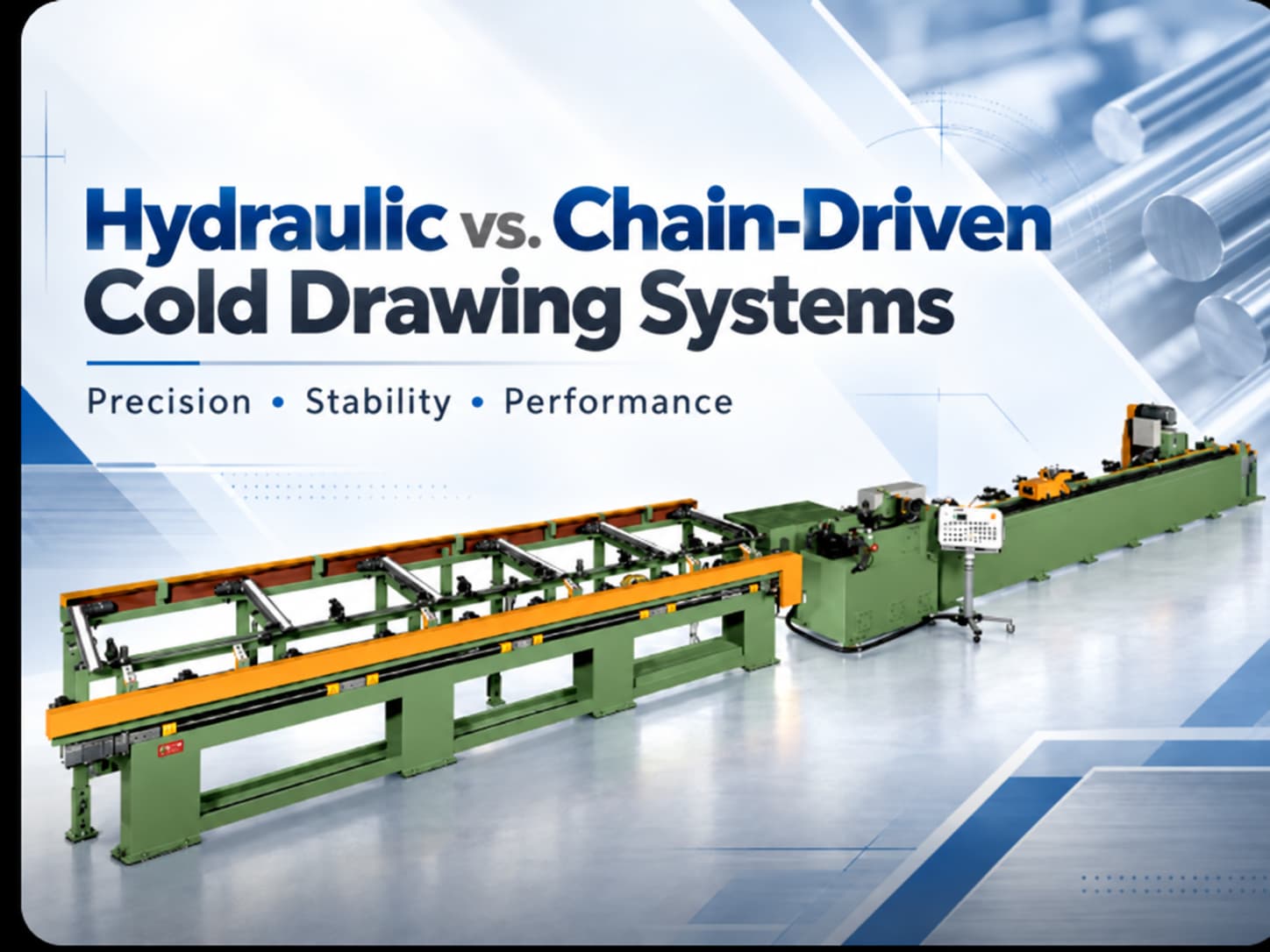
Choosing a cold drawing machine involves more than selecting pulling force or drawing speed. For manufacturers producing precision metal bars, rods, and tubes, the drive system can influence pulling-force control, speed consistency, maintenance requirements, and production efficiency.
Hydraulic and chain-driven cold drawing systems use different methods to generate pulling movement. However, neither system automatically guarantees better dimensional accuracy. The right choice depends on material properties, drawing requirements, machine configuration, and production goals.
This guide compares the two drive systems and explains what manufacturers should evaluate before investing in cold drawing equipment.
Evaluating equipment for your production line? Explore HOREN cold drawing machines or contact our team to discuss your manufacturing requirements.
1. Hydraulic vs. Chain-Driven Cold Drawing Systems: Key Differences
Both systems pull metal through a drawing die to reduce its cross-section and achieve the required dimensions. Their primary difference is how the drawing carriage is driven.
| Comparison | Hydraulic Drive | Chain-Driven System |
|---|---|---|
| Drive principle | Hydraulic cylinders generate pulling movement. | A motor-driven chain transmission moves the drawing carriage. |
| Force control | Depends on hydraulic pressure and control design. | Depends on motor torque, gearing, and transmission design. |
| Speed stability | Influenced by hydraulic flow, temperature, and control response. | Influenced by motor control, loading, and transmission condition. |
| Dimensional accuracy | Depends on tooling, alignment, material, and system stability. | Depends on tooling, alignment, material, and system stability. |
| Maintenance | Fluid, seals, valves, hoses, and cylinders. | Chains, sprockets, lubrication, bearings, and drive components. |
| Machine selection | Evaluate force, stroke, speed, and hydraulic-system design. | Evaluate pulling capacity, drawing length, transmission, and automation. |
2. Which Drive System Delivers Better Precision?
Precision is often the main concern when manufacturers compare a hydraulic cold drawing machine with a chain-driven system. However, hydraulic drive does not inherently deliver better dimensional accuracy.
Important factors affecting drawing precision include:
- Die geometry and condition: Die dimensions, wear, and alignment directly affect the finished profile.
- Drawing-force stability: Changes in drawing resistance can affect processing consistency.
- Drawing-speed control: Suitable, stable speed helps maintain repeatable operating conditions.
- Material characteristics: Strength, hardness, incoming tolerances, and work hardening affect deformation.
- Lubrication: Proper lubrication helps manage friction, die wear, and surface quality.
- Machine rigidity and alignment: Stable carriage guidance and structural support are important for consistent drawing.
Hydraulic Drive and Precision
A properly designed hydraulic system can control cylinder movement through hydraulic pressure and flow regulation. Depending on the configuration, sensors and feedback controls may provide additional force or speed regulation.
Actual performance still depends on hydraulic-system response, equipment rigidity, die quality, and the material being processed.
Chain-Driven Systems and Precision
A chain-driven cold drawing machine uses a mechanical transmission to move the drawing carriage. With appropriate motor control, chain maintenance, and mechanical alignment, it can provide repeatable drawing movement.
HOREN's chain-driven cold drawing machines offer customizable pulling force, drawing speed, and drawing length for different production requirements.
3. Drawing Speed, Stability, and Maintenance Costs
Drawing Speed and Stability
Hydraulic drawing systems can provide adjustable movement and force control. Their speed stability depends on the hydraulic circuit, pump capacity, fluid condition, and control system.
Chain-driven systems transmit motion mechanically. Drawing-speed stability depends on motor regulation, drive components, chain condition, and changes in drawing resistance.
Neither system is universally faster. Actual drawing performance should be evaluated at the required pulling load and operating speed.
Maintenance Requirements
Hydraulic systems require regular attention to fluid cleanliness, seals, hoses, valves, and possible leakage. Chain-driven systems require inspection of chain wear, tension, lubrication, sprockets, and mechanical alignment.
For a meaningful long-term comparison, manufacturers should consider:
- Replacement parts and maintenance labor
- Energy consumption under operating conditions
- Expected downtime and maintenance intervals
- Equipment utilization and production requirements
4. Which System Is Suitable for Different Materials?
Both hydraulic and chain-driven systems can process different metals when correctly specified for the required drawing load, material dimensions, and tooling configuration.
| Material | Important Drawing Considerations |
|---|---|
| Carbon Steel | Drawing force, hardness, die wear, and dimensional consistency. |
| Alloy Steel | Material strength, work hardening, drawing load, and die selection. |
| Aluminum | Surface protection, lubrication, and dimensional control. |
| Copper and Brass | Surface finish, deformation behavior, and profile accuracy. |
| Metal Tubes | Wall thickness, internal support where required, and straightness. |
For example, high-strength steel generally requires a different drawing-force assessment from a similarly sized softer non-ferrous material. This does not automatically make either drive system preferable.
Material compatibility must be confirmed against the machine's rated capacity, material grade, starting dimensions, required reduction, and tooling design.
5. How HOREN Combines Chain-Driven Drawing with Hydraulic Automation
Hydraulic and chain-driven mechanisms are not necessarily competing technologies within a production line.
HOREN INDUSTRIAL's automatic cold drawing machines integrate a chain-driven drawbench, hydraulic push pointer, and PLC-controlled material handling.
The chain-driven carriage provides the main pulling movement. The hydraulic push pointer prepares and pushes the leading end of the workpiece through the drawing die so it can be gripped for the subsequent drawing operation. This arrangement can reduce the need for a separate pointing process in suitable applications.
Combined with loading, feeding, and discharging mechanisms, the HS series is designed to support automated bar-to-bar cold drawing operations.
HOREN HS Series: Automatic Cold Drawing Machines
HS200 / HS200P Automatic Bar Drawing Machine
Published motor specification: HS200 – 30 HP.
A chain-driven automatic drawbench for smaller-section metal bars and related drawing applications. Machine suitability depends on material and finished dimensions.
HS300 / HS300P Automatic Bar Drawing Machine
Published motor specification: HS300 – 50 / 75 HP.
An automatic cold drawing solution for applications requiring different pulling-force and material-size configurations, with customizable drawing parameters.
HS400 Automatic Bar Drawing Machine
Published motor specification: 75 / 100 HP.
A larger-capacity automatic drawbench designed for metal bars, rods, and suitable profiles, with optional cutting and straightening integration.
Note: Motor ratings are not equivalent to pulling-force ratings. Available material sizes, drawing capacities, and configurations must be confirmed for each model.
6. How to Choose the Right Cold Drawing Machine
Before requesting a quotation, manufacturers should define five essential production requirements:
- Material and profile: Specify the material grade and whether the workpiece is round, square, hexagonal, tubular, or another profile.
- Starting and finished dimensions: Provide incoming dimensions, target dimensions, drawing length, and reduction requirements.
- Required tolerances: Identify dimensional accuracy, surface finish, and straightness requirements.
- Production capacity: Define batch size, expected output, operating schedule, and desired automation level.
- Operating considerations: Evaluate maintenance resources, available factory space, and downstream processing requirements.
For a broader equipment-selection overview, read How to Choose the Right Cold Drawing Machine for Your Manufacturing Needs.
Providing these specifications helps equipment manufacturers assess appropriate machine capacity, drive configuration, tooling, and customization options.
7. Frequently Asked Questions
Is a hydraulic cold drawing machine more precise than a chain-driven machine?
Not necessarily. Both systems can produce precise components when properly designed and controlled. Final accuracy depends on tooling, material properties, machine rigidity, alignment, and process stability.
Which cold drawing system requires less maintenance?
There is no universal answer. Hydraulic systems require fluid and hydraulic-component maintenance, while chain-driven systems require mechanical transmission inspections and lubrication. Maintenance frequency and costs depend on operating conditions and equipment design.
Can chain-driven cold drawing machines process high-strength steel?
Yes, provided the machine has sufficient pulling capacity and is appropriately configured for the material, starting dimensions, reduction, and tooling requirements.
Does an automatic cold drawing machine require a hydraulic pulling system?
No. Automatic equipment can use a chain-driven main pulling mechanism with hydraulic components for auxiliary operations. HOREN's HS series combines chain-driven drawing with a hydraulic push pointer and PLC-controlled automation.
Conclusion: Choose the Drive System That Meets Your Production Requirements
Hydraulic and chain-driven cold drawing systems use different approaches to generating and controlling drawing movement. Neither drive type alone determines precision, productivity, or equipment quality.
Manufacturers should focus on pulling capacity, speed stability, required tolerances, material compatibility, automation, and long-term operating costs.
HOREN INDUSTRIAL provides chain-driven cold drawing machines and automated drawing solutions for metal bars, rods, tubes, and suitable profiles, with configurations tailored to different processing needs.
Looking for a Cold Drawing Machine for Your Production Line?
Share your material type, starting and finished dimensions, required tolerances, drawing length, and production capacity. HOREN's team can help evaluate suitable equipment configurations for your application.
Contact HOREN for an InquiryYou can also explore our Cold Drawing Machines and Automatic Cold Drawing Machines.
